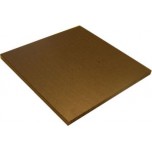
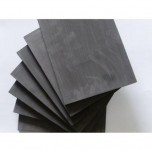
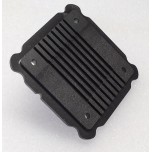
Fuel Cell Grade Graphite Plates can be machined on both sides to be used as bi-polar plates. These plates exhibit high electrical and thermal conductivity, incredible resistance to chemicals, and are densified and resin-filled for low permeability.
Thickness Tolerance: +/- 0.003 in
Length and Width Tolerance: +/- 0.1 in
Technical Specifications:
- Bulk density: 1.95 g/cm3
- Particle size: 13 - 15 microns
- Shore hardness: 85 HSD
- Breaking strength: 60 MPa
- Compressive strength: 200 MPa
- Max temperature it can handle in oxidative environments: 200 deg C
- Electric Resistivity: 11 - 13 micro.Ohm.meter
- Coefficient of Expansion: 4.8 x 10^-6 per deg C
Scientific Literature Relevant to This Product:
An article by Quentin Meyer and his colleagues (through a collaboration between University of South Wales, Newcastle University, and Paul Scherrer Institute) entitled "Lateral bypass flow fields for high-performance flood-free hydrogen fuel cells" describes the use of fully resin impregnated graphite plates procured from Fuel Cell Store and custom made 0.1, 0.2, and 0.4 mg/cm² 20% Platinum on Vulcan - Carbon Paper Electrode (by Fuel Cell Store) in their lateral bypass concept for the PEMFC graphite bipolar plates and achieving excellent performance. Bipolar plates manufactured from the "Fully resin impregnated graphite plates" and all of the custom made GDE products achieved current densities in the range of 2 to 4 A/cm² in a Hydrogen-Air PEM fuel cell at ambient pressure. In addition to these custom gas diffusion electrodes, the researchers experimented with 0.1 mg/cm² 20% Platinum Cobalt alloy supported on Vulcan - Carbon Paper Electrode with their novel lateral bypass concept for the bipolar plate (that was manufactured from Fully Resin Impregnated Graphite Plates) and achieved greater than 2 A/cm² current density in a Hydrogen-Air PEM fuel cell at ambient pressure. The extensive nature of this publication makes it an excellent reading material for electrochemists in the field of PEM fuel cells, especially for the researchers that are studying flooding phenomenon and how to mitigate it while using the typical PEM fuel cell components.