
Your shopping cart is empty!
+1 (855) 251-0016 | sales@fuelcellstore.com

Categories
Quick Add To Cart
Membranes
In order for a PEM fuel cell to operate, a Proton Exchange Membrane is needed that will carry the hydrogen ions, proton, from the anode to the cathode without passing the electrons that were removed from the hydrogen atoms. These polymer membranes that conduct proton through the membrane but are reasonably impermeable to the gases, serve as solid electrolytes (vs. liquid electrolyte) for variety of electrochemical applications, and are commonly known as Proton Exchange Membrane and/or Polymer Electrolyte Membranes (PEM). These membranes have been identified as one of the key components for various consumer related applications for fuel cells, e.g. automobiles, back-up power, portable power etc. Due to its application for many consumer markets, the technology keeps on evolving to make these membranes suitable for longer duration, and even high temperature operations.
For PEM fuel cell and electrolyzer applications, a polymer electrolyte membrane is sandwiched between an anode electrode and a cathode electrode. During electrochemical reaction, oxidation reaction at the anode generates protons and electrons; reduction reaction at the cathode combines protons and electrons with oxidants to generate water. To complete the electrochemical reaction, the proton exchange membrane plays a critical role that conducts protons from anode to cathode through the membrane. The proton exchange membrane also performs as a separator for separating anode and cathode reactants in fuel cells and electrolyzers.
Main Types of Fuel Cell Ion Exchange Membranes
• Cation Exchange Membrane (CEM)
• Anion Exchange Membrane (AEM)
• Bipolar Membranes
• Chlor-alkali Production Membranes
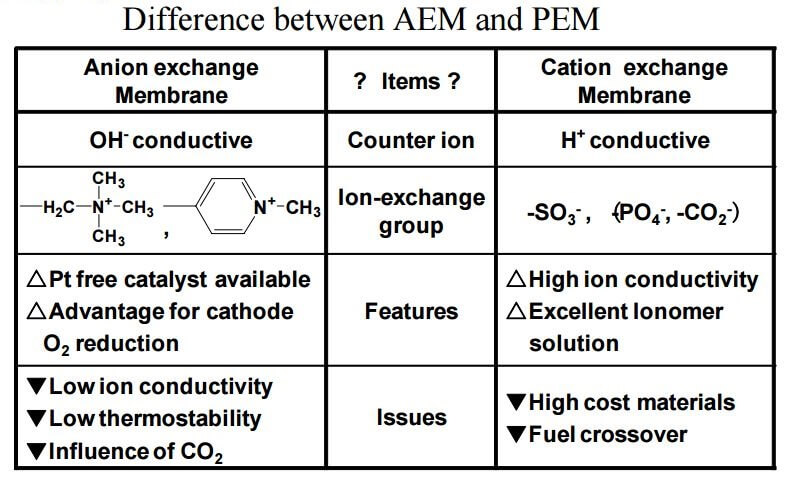
Whats is the Difference Between Cation and Anion Exchange Membranes?
Cation Exchange Membranes (CEM) are usually comprised of a fluorinated polymer with sulfonic acid sites and have excellent ionic conductivity and thermal/chemical durability. Currently manufactured Anion Exchange Membranes (AEMs) can utilize various alkaline stable polymeric materials as the host material and come with various functional sites that conducts OH- or any other anionic species. Thermal/chemical durability of AEMs are in general lower compared to its CEM counterparts.
Refine Search


